

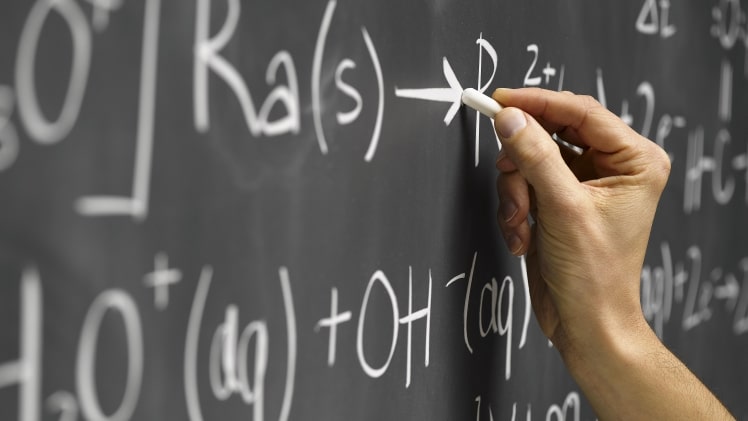
We come across many chemical reactions in our day-to-day life that go unnoticed. In a chemical reaction, new products are formed from the given reactants. The cooking of food, cleaning of teeth, washing of clothes, the digestion of food and the growth of plants and animals are all chemical reactions. In Chemistry, we study these reactions in the form of chemical equations.
The chemical equations contain both quantitative and qualitative details of a chemical reaction. Each atom or element is written as a unique symbol. For example, the iron symbol is Fe; Hydrogen is H, chlorine is Cl, and so on. The left-hand side of a chemical equation represents the reactants, separated by a “+” sign followed by a reaction arrow to the right. The products are written on the right-hand side of the reaction arrow, separated by a “+” sign. Hence, the overall chemical equation is written as:
Reactants → Products
There can be one or more reactants and products in a chemical equation.
Importance of Balancing the Chemical Equations
The elements combine in a fixed ratio by mass to form a compound. Therefore, the chemical equations must be balanced quantitatively. A few points that determine the importance of balancing a chemical equation are mentioned below:
- It tells the exact number of moles of each chemical species present in the chemical reaction.
- It also helps to determine the limiting reactant in a chemical reaction.
The balancing of a chemical equation follows the law of conservation of mass, which means that the amount of a substance present before and after a reaction must be the same. This also implies that the number of moles of each element on either side of a chemical reaction must be the same. The Balancing of Chemical Equations Questions are asked very often in Chemistry examinations.
Examples of Balanced Chemical Equations Questions
Some examples of balanced and unbalanced chemical equations are given below.
- Unbalanced: C5H12 + O2 → CO2 + H2O
Balanced: C5H12 + 😯2 → 5CO2 + 6H2O
- Unbalanced: Zn + HCl → ZnCl2 + H2
Balanced: Zn + 2HCl → ZnCl2 + H2
- Unbalanced: S8 + F2 → SF6
Balanced: S8 + 24F2 → 8SF6
Balancing of a Chemical Equation
For the simple chemical reactions, the hit and trial method is used to balance the chemical equations. This method can be used to solve many Chemistry Important Questions. In this method, the elements that appear the least number of times in a chemical equation are balanced first, followed by the elements that occur more often.
For example, in reaction (1) above, there are five carbon atoms on the left side of the reaction arrow and only one carbon atom on the right side. So, carbon atoms are balanced by multiplying CO2 by 5.
Step 1: Balancing of carbon atoms.
C5H12 + O2 → 5CO2 + H2O
Now, there are five carbon atoms on both sides of the equation.
Step 2: Balancing of hydrogen atoms. There are 12 hydrogen atoms on the left and 2 Hydrogen atoms on the right. Hydrogen atoms are balanced by multiplying H2O with 6.
C5H12 + O2 → 5CO2 + 6H2O
Now, there are twelve hydrogen atoms on both sides of the equation.
Step 3: Balancing of oxygen atoms. There are two oxygen atoms on the left and sixteen oxygen atoms on the right. Oxygen atoms are balanced by multiplying O2 with 8.
C5H12 + 😯2 → 5CO2 + 6H2O
Now, there are sixteen oxygen atoms on both sides of the equation.
So, the resulting chemical equation after Step 3 is completely balanced.
