

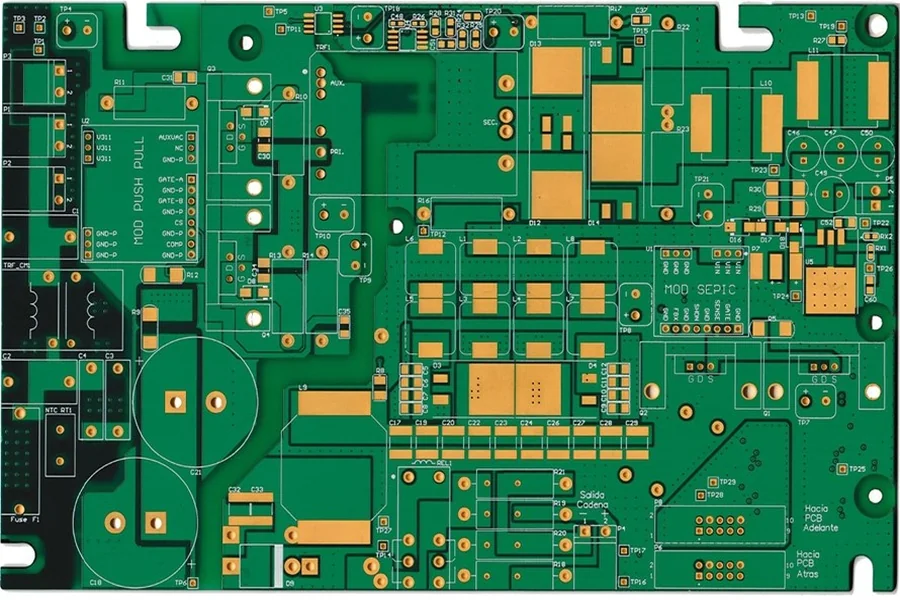
The Radar Circuit Board is a specialized printed circuit board designed to support radar systems that detect, locate, and track objects using radio waves. Unlike conventional PCBs used in consumer electronics, radar boards are built with advanced materials and precise layouts to handle high-frequency signals with minimal loss. They are engineered for superior reliability, performance, and accuracy because even a minor design flaw could compromise the radar’s ability to provide accurate information. Today, radar circuit boards are a critical part of defense systems, weather monitoring, automotive driver-assistance technologies, aviation control, and even space exploration. The growing demand for safer transportation, smarter navigation, and advanced communication has positioned radar PCBs as one of the most important technologies in the modern era.
Structure and Design of Radar Circuit Board
A Radar Circuit Board is far more complex than an ordinary board, as it must carry extremely high-frequency signals without interference or distortion. To achieve this, manufacturers use specialized substrates such as PTFE, ceramic-filled laminates, or hybrid materials that can maintain stability under high-speed operation. The copper thickness, trace width, and dielectric constant of the board material must be precisely controlled to ensure accurate signal transmission. Designers also rely on advanced techniques like microstrip and stripline routing to maintain signal integrity, while multilayer construction allows integration of power distribution, ground planes, and high-frequency components in a compact format.
Heat dissipation is another critical factor in radar PCB design. High-frequency radar systems generate substantial thermal loads, and improper heat management can lead to degraded performance or even system failure. To address this, radar boards often integrate thermal vias, metal-backed substrates, and carefully engineered layouts to ensure efficient heat transfer. Shielding and isolation are equally important, as radar systems must operate without interference from nearby electronic components or environmental noise.
Applications of Radar Circuit Board
The Radar Circuit Board is widely used across multiple industries due to its ability to process and transmit high-frequency signals with precision. In the defense sector, radar boards are essential in surveillance, missile guidance, and battlefield monitoring systems, providing reliable detection even under extreme conditions. In aviation and air traffic control, radar circuit boards power the systems that track aircraft and manage flight safety. Meteorology heavily depends on radar PCBs for weather prediction, storm monitoring, and early warning systems that save lives during natural disasters.
The automotive industry has recently become one of the fastest-growing consumers of radar technology. Advanced driver-assistance systems (ADAS) rely on radar boards for collision avoidance, adaptive cruise control, blind-spot detection, and autonomous driving capabilities. Similarly, the maritime sector uses radar circuit boards to navigate ships safely, even in poor visibility. Beyond Earth, radar technology plays a vital role in space missions, supporting planetary mapping, satellite communication, and extraterrestrial exploration. These diverse applications highlight the indispensable role of radar PCBs in both civilian and military fields.
Advantages of Radar Circuit Board
The Radar Circuit Board delivers several advantages that make it superior to conventional PCBs in high-frequency applications. Its most significant strength lies in its ability to handle microwave and millimeter-wave frequencies with exceptional accuracy, which ensures reliable detection and communication. The use of advanced materials allows these boards to operate effectively in harsh environments, from extreme heat in military operations to freezing temperatures in aerospace applications. Another advantage is their durability and reliability, as radar systems are often mission-critical and must perform flawlessly over extended periods. Radar PCBs are also highly customizable, allowing engineers to design boards tailored to specific requirements, whether that involves compact designs for vehicles or high-power boards for long-range defense systems.
Evolution of Radar Circuit Board Technology
The Radar Circuit Board has evolved tremendously over the decades. Early radar systems were large, power-hungry, and relied on bulky vacuum tubes and mechanical components. With the advancement of semiconductor technology, miniaturization became possible, and radar boards transitioned to transistor-based systems with greater efficiency. The introduction of printed circuit boards revolutionized radar technology, enabling compact, reliable, and cost-effective designs. Today, the integration of surface-mount technology, multilayer construction, and advanced simulation software has pushed radar PCB performance to unprecedented levels.
The latest evolution comes from the integration of 5G and millimeter-wave technologies, which demand radar boards that can handle extremely high frequencies with low loss. This advancement is opening up new possibilities, particularly in autonomous vehicles, smart infrastructure, and next-generation communication networks. As radar systems continue to expand into new industries, the demand for innovative radar circuit board designs is only expected to grow.
Challenges in Radar Circuit Board Design
Designing a Radar Circuit Board presents challenges that require precision engineering and deep expertise. The most significant challenge is ensuring signal integrity at very high frequencies, where even minor variations in trace length or material properties can cause major distortions. Thermal management remains another concern, as high-power radar systems generate heat that must be effectively controlled to maintain performance. Electromagnetic interference (EMI) is also a major challenge, requiring careful board layout and shielding strategies to minimize unwanted noise. Additionally, the cost of advanced materials and specialized manufacturing processes makes radar boards more expensive than standard PCBs, which can be a barrier for some industries. Despite these challenges, continuous innovation and investment in advanced PCB manufacturing techniques are helping overcome these limitations.
Conclusion
The Radar Circuit Board is a cornerstone of modern technology, enabling accurate detection, reliable communication, and advanced automation across numerous industries. Its unique ability to manage high-frequency signals, withstand extreme conditions, and deliver consistent performance makes it vital for defense, aerospace, automotive, meteorology, and beyond. As demand for smarter, safer, and more efficient systems continues to grow, radar PCBs will play an even greater role in shaping the future of technology. For businesses and industries seeking dependable and high-performance radar solutions, partnering with an experienced Radar Circuit Board Manufacturer ensures access to boards that meet the most demanding requirements of quality, reliability, and precision.
